

Rural Agriculture’s Connection to Postbellum Economic Growth
Written by Austin Valentine, Jr.
One of the most significant contributions to postbellum economic growth in the United States can be directly attributed to advancements in rural agriculture. Today, most individuals do not realize the critical role that farming in North America played in the United States’ economic history – consisting of practices that date back well before the country’s founding. From rural homesteads to large-scale operations involving thousands of acres, farming was once the backbone of the American economy.
It established its foothold during the early eras of North American history, such as the establishment of the New England Colonies, slavery in the Antebellum South, and westward territorial expansion. Moreover, it when through another transformation altogether with the introduction of mechanized farming equipment - producing substantial yearly economic growth. The impact of ever-changing agriculture and agricultural practices was such that in the middle of the 20th century, 400 years since Europeans arrived at Jamestown, nearly two-thirds of the United States consisted of farmland.[1] However, in the years since, farming has started to decline across the United States – reaching just over 40% by 2012.[2]
Even though farming in America has a rich history dating back to the 17th century, statistical tracking and government-mandated documentation of farms and farming practices did not begin until the 1820s. It first took shape with the collection of the 1820 census data, which counted the number of individuals engaged in farming practices.[3] By the 1860s, the census had grown, collecting farm data on a multitude of products and livestock. It documented tobacco, Indian corn, wheat, cotton, hemp, honey, wool, horses, cattle, sheep, and much more.[4]
Such agricultural growth prompted then-President Abraham Lincoln to sign a bill on May 15, 1862, creating the United States Department of Agriculture (USDA.).[5] Ever since its creation, the USDA has continued to promote farming and farming practices, aiding agricultural growth during the mid to late 19th century. Moreover, such development during that era had a direct impact on industrialization. Businesses such as cotton and textile mills, farm equipment manufacturers, food processing and packaging plants, livestock slaughterhouses, and meatpacking facilities all grew alongside agricultural production, scattered across urban and rural landscapes.
In my Western Kentucky Home of Crittenden County, farming has been a critical component of economic growth ever since the county’s founding in 1842. According to the 1850 Crittenden County Kentucky Census, the county consisted of 6,351 residents, out of whom 1184 were working-age males, 715 of which engaged in farming.[6] By 1860, the county had grown to 1817 working-age males, 1084 of whom were farmers.[7] Therefore, roughly 60% of working-aged males were engaged in farming in Crittenden County before the American Civil War.
However, by the turn of the 21st century, farming in rural Crittenden County had decreased significantly compared to the county’s population. According to the Kentucky State Data Center, Crittenden County consisted of 6,946 working-age individuals.[8] Out of these, there were only 698 total farms, with a mere 662 working-age individuals engaged in farming practices throughout the county.[9]
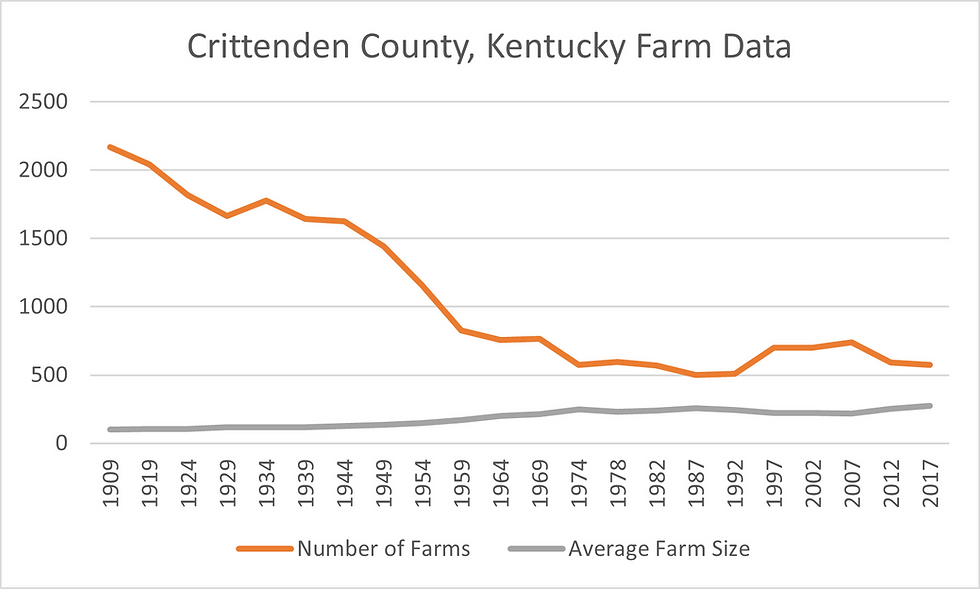
After 1900, the number of farms began to sharply decrease in Crittenden County due to a growing number of spar mining operations that sprang up across the county. Moreover, those who were not engaged in spar mining often traveled to adjacent counties to work in the coal mines. This rapid change in employment is visible in the chart above, which shows a sharp decrease in the number of farms and an increase in the average farm size in Crittenden County from 1909 through 2017.[10] Even though the number of farms has decreased since the turn of the century, its early role set both Crittenden County and Western Kentucky on a path toward economic growth. Sadly, as generations pass, the part that farming played in the local community and the oral history of farming practices steadily becomes lost to the ages.
[1] Orville L. Freeman, ed., After A Hundred Years - Yearbook of Agriculture 1962 (Washington, D.C.: United States Department of Agriculture, 1962), 57. [2] United States Department of Agriculture, “Farms and Farmland,” United States Department of Agriculture, last modified 2014, accessed May 24, 2021, https://www.nass.usda.gov/Publications/Highlights/2014/Highlights_Farms_and_Farmland.pdf. [3] United States Census Bureau, “Census of Agriculture,” Census of Agriculture, last modified December 17, 2020, accessed May 24, 2021, https://www.census.gov/history/www/programs/agriculture/census_of_agriculture.html. [4] United States Census Bureau, “1860 Agricultural Census Schedule” (United States Census Bureau, 1860), National Archives, accessed May 26, 2021, https://www.archives.gov/files/research/genealogy/charts-forms/1860-agricultural.pdf. [5] Freeman, After A Hundred Years - Yearbook of Agriculture 1962, 7. [6] United States Census Bureau, “Kentucky” (United States Census Bureau, 1850), United States Census Bureau, accessed May 27, 2021, https://www2.census.gov/library/publications/decennial/1850/1850a/1850a-39.pdf. [7] United States Census Bureau, “State of Kentucky - Table No. 1 Population by Age and Sex” (United States Census Bureau, 1860), United States Census Bureau, accessed May 27, 2021, https://www2.census.gov/library/publications/decennial/1860/population/1860a-15.pdf. [8] University of Louisville, “Total Population by Age and Sex (1960 – 2010)” (Kentucky State Data Center, 2021), University of Louisville, accessed May 28, 2021, http://www.ksdc.louisville.edu//wp-content/uploads/2015/06/age-and-sex-1960-2010.xls. [9] USDA, “Kentucky Census of Agriculture, 1997 & 2002” (United States Department of Agriculture, 2021), United States Department of Agriculture, accessed May 28, 2021, https://www.nass.usda.gov/Statistics_by_State/Kentucky/Publications/Annual_Statistical_Bulletin/2005/p022.pdf. [10] USDA, “Crittenden County” (United States Department of Agriculture, December 8, 2020), United States Department of Agriculture, accessed May 28, 2021, https://www.nass.usda.gov/Statistics_by_State/Kentucky/Publications/State_Census_Summaries/Historical_Ag_Statistics/Crittenden.pdf.
References
Beckert, Sven. Empire of Cotton - A Global History, Commercial Agriculture, The Slave Trade. New York, NY: Vintage Books, 2014.
Conrad, Alfred H., and John R. Meyer. The Economics of Slavery and Other Studies in Econometric History. Chicago, IL: Aldine Publishing Company, 1970.
Cooper Jr., William J., and Thomas E. Terrill. The American South - A History. Lanham, MD: Rowman & Littlefield Publishers, Inc., 2009.
Freeman, Orville L., ed. After A Hundred Years - Yearbook of Agriculture 1962. Washington, D.C.: United States Department of Agriculture, 1962.
McKenna, Joseph P. Aggregate Economic Analysis. 3rd ed. Hinsdale, IL: The Dryden Press, Inc., 1969.
United States Census Bureau. “1860 Agricultural Census Schedule.” United States Census Bureau, 1860. National Archives. Accessed May 26, 2021. https://www.archives.gov/files/research/genealogy/charts-forms/1860-agricultural.pdf.
———. “Census of Agriculture.” Census of Agriculture. Last modified December 17, 2020. Accessed May 24, 2021. https://www.census.gov/history/www/programs/agriculture/census_of_agriculture.html.
———. “Kentucky.” United States Census Bureau, 1850. United States Census Bureau. Accessed May 27, 2021. https://www2.census.gov/library/publications/decennial/1850/1850a/1850a-39.pdf.
———. “State of Kentucky - Table No. 1 Population by Age and Sex.” United States Census Bureau, 1860. United States Census Bureau. Accessed May 27, 2021. https://www2.census.gov/library/publications/decennial/1860/population/1860a-15.pdf.
United States Department of Agriculture. “Farms and Farmland.” United States Department of Agriculture. Last modified 2014. Accessed May 24, 2021. https://www.nass.usda.gov/Publications/Highlights/2014/Highlights_Farms_and_Farmland.pdf.
University of Louisville. “Total Population by Age and Sex (1960 – 2010).” Kentucky State Data Center, 2021. University of Louisville. Accessed May 28, 2021. http://www.ksdc.louisville.edu//wp-content/uploads/2015/06/age-and-sex-1960-2010.xls.
USDA. “Crittenden County.” United States Department of Agriculture, December 8, 2020. United States Department of Agriculture. Accessed May 28, 2021. https://www.nass.usda.gov/Statistics_by_State/Kentucky/Publications/State_Census_Summaries/Historical_Ag_Statistics/Crittenden.pdf.
———. “Kentucky Census of Agriculture, 1997 & 2002.” United States Department of Agriculture, 2021. United States Department of Agriculture. Accessed May 28, 2021. https://www.nass.usda.gov/Statistics_by_State/Kentucky/Publications/Annual_Statistical_Bulletin/2005/p022.pdf.

Comments