

Does Anybody Know What Triggered the Great Depression?

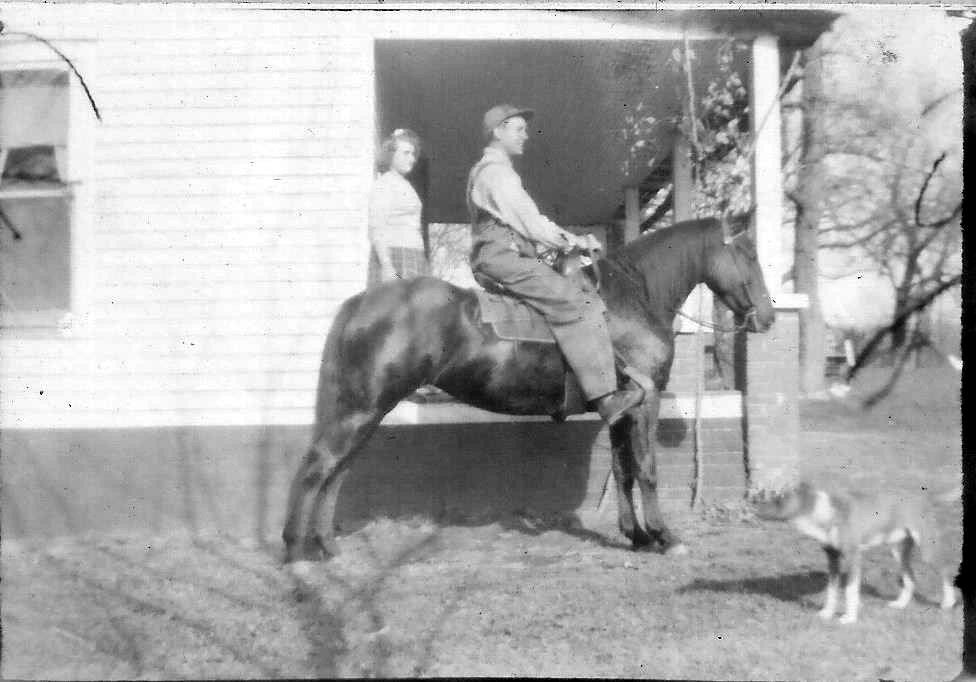
(Photograph provided by Austin Valentine, Jr. from his personal family collection)
Ever since October 29, 1929, also known as “Black Tuesday,” economists and historians have tried their best to determine what actually caused the events leading to the American Great Depression. Thus far, these hypotheses have been little more than research-based speculation, with most theories having a fair degree of substantiation to produce a valid argument. Nevertheless, the question of what triggered the Great Depression remains at large within the academic community.
One of the most widely accepted reasons for the 1929 stock market crash involves the easy credit lines that consumers had access to after World War I. According to the Corporate Finance Institute, they explain this as being “investor optimism and consumer spending…spurred by the post-war years of the 1920s.”[1] However, David Wheelock of the Federal Reserve Bank of St. Louis explained that the 1929 market crash was just one instance in a series of events that resulted in the Great Depression. He noted that the most probable reasoning for the depression was a combination of the market crash, bank failure, and the collapse of trade resulting from the Smoot-Hawley Tariff.[2]
Nevertheless, there were a number of theories that immediately surfaced in the wake of the 1929 crash. In an October 31, 1929, article in The Baltimore Sun, the blame is immediately placed upon the shoulders of the G.O.P. leaders. According to Senator Joseph T. Robinson, the G.O.P started the landslide through repeated optimistic statements to Washington and the American people – citing that these statements were “…unduly and repeated.”[3] This idea is a subject that David Wheelock of the Federal Reserve Bank of St. Louis touched upon - noting that this was not likely the case.[4]
However, as the country began entering into the Great Depression, the American people began to experience its effects differently. In a November 19, 1929, article in The Baltimore Sun, called “Bankers Try To Save Brokers Who Failed,” convey to the public that brokerage and investment firms were being forced out of business due to the plummeting economy. They explain how a Providence Firm went into debt between $4,000,000 and $5,000,000 nearly overnight.[5] Such losses triggered some brokers and investors to go so far as to take their own life, committing suicide instead of facing their clients. Such was the case with St. Louis investor John F. Betts, who lost $400,000. This collapse prompted the 59-year-old member of the New York Stock Exchange to take his own life less than 30 days after the market crash.[6]
It was these kinds of activities that David Wheelock lumped together with the Stock Market crash itself. He explained that events such as these prompted individuals to make runs on local banks to retrieve their money. Moreover, it also caused people to curb spending and be more conservative with their choice of purchases. These events, as a whole, are what Mr. Wheelock claims to have triggered the Great Depression.[7] Moreover, the Corporate Finance Institute adds to Wheelock’s assumption by including that during the onset of the depression, the United State’s money supply dropped by nearly 35% - citing this as being one instance of what Wheelock referred to as a banking failure.[8]
Nevertheless, the exact reason why the United States experienced the Great Depression is still a hotly contested subject. There has not been a wholly accepted reasoning for the Great Depression, other than it happened, affected different areas of the country differently, and plunged the United States into a state of uncertainty on the world stage. Therefore, it is next to impossible to nail down any aspect or combination thereof that can be directly attributed to forcing the United States into economic oblivion. One thing about the depression that was inevitable was the uncertainty that the American people had from day to day – some not knowing from where their next meal was coming.
[1] CFI Education Inc., “The Great Depression Overview and Economic Explanations,” CFI Education Inc., last modified 2021 2015, accessed June 14, 2021, https://corporatefinanceinstitute.com/resources/knowledge/economics/the-great-depression/. [2] Federal Reserve Bank of St. Louis, “Economic Episodes in American History: The Great Depression,” Federal Reserve Bank of St. Louis, last modified 2021, accessed June 14, 2021, https://www.stlouisfed.org/the-great-depression/curriculum/economic-episodes-in-american-history-part-5. [3] “Blame For Stock Market Crash Placed Upon G. O. P. Leaders: Hoover, Coolidge And Mellon Started Trouble By Repeated Optimistic Statements, Senator Robinson, Democrat, Charges,” The Sun (1837-1995) (Baltimore, Md., October 31, 1929), http://ezproxy.liberty.edu/login?qurl=https%3A%2F%2Fwww.proquest.com%2Fhistorical-newspapers%2Fblame-stock-market-crash-placed-upon-g-o-p%2Fdocview%2F542057608%2Fse-2%3Faccountid%3D12085. [4] Federal Reserve Bank of St. Louis, “Economic Episodes in American History: The Great Depression.” [5] “Bankers Try To Save Brokers Who Failed: Market Crash Carries Providence Firm Down With Debts Of $5,000,000,” The Sun (1837-1995) (Baltimore, Md., November 19, 1929), http://ezproxy.liberty.edu/login?qurl=https%3A%2F%2Fwww.proquest.com%2Fhistorical-newspapers%2Fbankers-try-save-brokers-who-failed%2Fdocview%2F543455008%2Fse-2%3Faccountid%3D12085. [6] “SUICIDE IS BLAMED ON MARKET CRASH: ST. LOUIS MEMBER OF N. Y. EXCHANGE HAD LOST $400,000 IN RECENT COLLAPSE BOUGHT $478,000 SEAT JOHN F. BETTS STAKED ALL TRYING TO CARRY CUSTOMERS THROUGH CRISIS, SAYS FAMILY,” The Sun (1837-1995) (Baltimore, Md., November 24, 1929), http://ezproxy.liberty.edu/login?qurl=https%3A%2F%2Fwww.proquest.com%2Fhistorical-newspapers%2Fsuicide-is-blamed-on-market-crash%2Fdocview%2F543475704%2Fse-2%3Faccountid%3D12085. [7] Federal Reserve Bank of St. Louis, “Economic Episodes in American History: The Great Depression.” [8] CFI Education Inc., “The Great Depression Overview and Economic Explanations.”

Comments