

Kentucky Fluorspar and Ben E. Clement
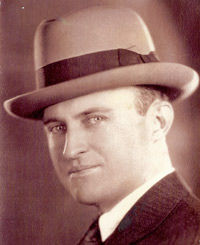
(Ben E. Clement Mineral Museum, “Ben E. Clement Mineral Museum - About Us,” Ben E. Clement Mineral Museum, last modified 2021, accessed June 10, 2021, https://www.clementmineralmuseum.org/about.shtml.)
Kentucky Fluorspar and Ben E. Clement
By Austin Valentine, Jr.
Today, when the old folk gather in the lobby of the Marion, Kentucky McDonalds, or Dairy Queen, they often reflect on their childhood – discussing how things have changed so much over such a short period. These reflections usually include discussing the once-thriving Fluorspar/Fluorite industry, which put Western Kentucky on the map from the early to the mid-20th century. They talk about the once numerous mining operations scattered across the area, where their fathers often worked long and hard days mining, loading, and hauling Fluorite. However, not a single conversation fails to mention Benjamin E. Clement, who brought the Fluorspar industry to life in the early to mid-1900s.
Early geologists determined during the late 1800s that a unique vein of Fluorite existed in Western Kentucky and Southern Illinois – sticking out of the ground in many locations. Evidence exists that the mineral was once used by early indigenous peoples residing in the area, who often carved statues from the crystal-like material.[1] One such artifact, a Fluorite statue that dated back to the 1100s, was unearthed in the Crittenden County town of Tolu, Kentucky, in the mid-1900s. However, it was not until the mid-1800s when commercial use of Fluorite began to emerge.
Therefore, during the latter part of the 19th century, several area farmers became miners, and landowners became prospectors and mine owners. In addition, new families moved into the area seeking wealth, with the population in Crittenden County growing from 9,381 in 1870 to 15,191 by the turn of the 20th century.[2] Most of these new settlers, and residents, often worked in the mines between planting and harvesting seasons.[3]
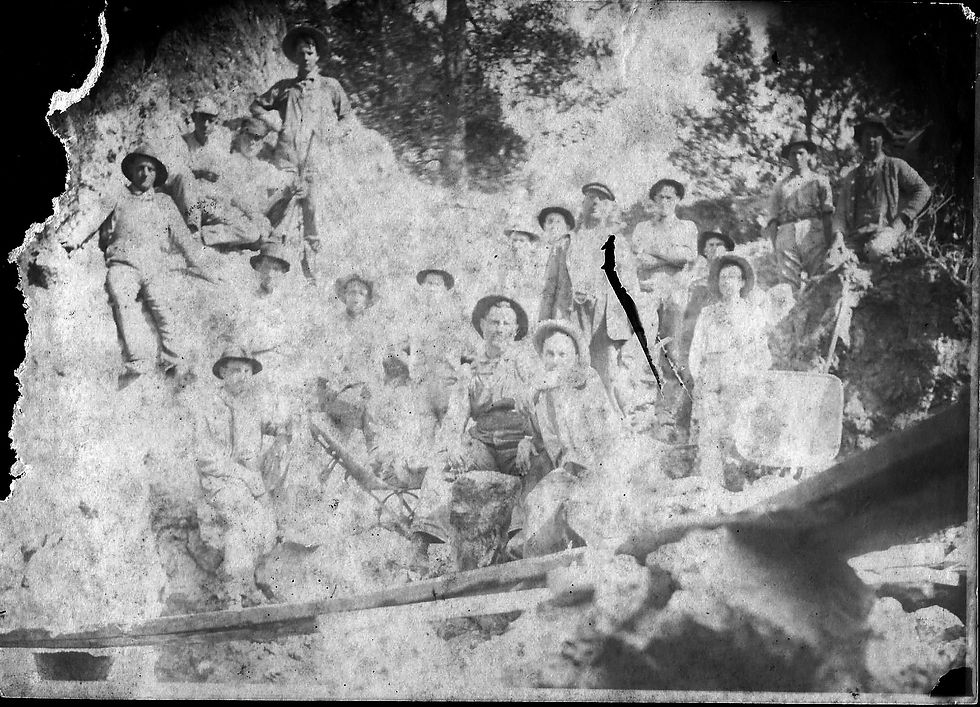
(Photograph of the Corn Mines Provide by Austin Valentine, Jr.)
For most residents of present-day Crittenden and Livingston, their ancestry is linked to the once-thriving fluorspar industry. One such example looms in my own family tree, through my great-great-grandfather John William Corn, property owner/mine foreman of what was once known as the Corn Mines. He and his employees – primarily relatives who made $69.20 for a six-day workweek – hauled tons of the precious mineral to the town of Marion, Kentucky, where it was loaded on rail cars.[4] At that time, the mined Fluorspar was bound for Buffalo, New York or Muncie, Indiana to the Ball Brother’s Glass Manufacturing Company, Inc. – where the material made the colorful blue Ball Canning Jars.[5]
However, if it were not for the efforts of Benjamin E. Clement, the exponential growth of mines established in the 19th-century, such as the Corn Mines, would most likely not have grown beyond simple family operations. Even though mining in the area dated back to the mid-19th century, most area elders feel that Mr. Clement’s geological knowledge turned small local operations into a Western Kentucky industry – helping to marry Western Kentucky Fluorspar with the booming northern steel industry.
Benjamin Edwin Clement, who held a Bachelor of Science from Vanderbilt University, was born September 6, 1891, in Humboldt, Tennessee. He moved to Crittenden County, Kentucky, between 1910 and 1920 – where Fluorspar mining had been in operation for nearly a half-century. As soon as he arrived in the county, he began making business contacts with area mining operations, even though he did not have enough financial means to begin any operations independently. These relationships forwarded him the opportunity to begin consulting with several of the local operations.[6]
Ben hit the ground running, which was directly attributed to his geological knowledge. As he traveled from mine to mine, he often collected specimens of the Fluorspar mined at each location. This love, and his dream of owning his own mine, landed Benjamin opportunities that eventually became very lucrative, putting him in his own mining operations.[7] By this time, the bulk of Crittenden County Fluorspar was headed north to be utilized in the steel-making industry. Ben also began selling road-grade fluorite gravel and what was known as “acid lump spar,” which sold between $27 and $60 per ton. Most of his gravel-grade Fluorspar was used to gravel many of the dirt roads throughout Crittenden County.[8]
[1] Illinois State Geological Survey, “Fluorite: Illinois’ State Mineral,” Illinois State Geological Survey, last modified 2021, accessed June 12, 2021, https://isgs.illinois.edu/outreach/geology-resources/fluorite-illinois-state-mineral. [2] United States Census Bureau, “Population of Kentucky by Counties: 1790 to 1900” (United States Census Bureau, December 29, 1900), United States Census Bureau, accessed June 10, 2021, https://www2.census.gov/library/publications/decennial/1900/bulletins/demographic/25-population-ky.pdf. [3] Fohs Hall Community Arts Foundation, ed., Crittenden County Kentucky, vol. 1 (Marion, KY: Riverbend Publishing, 1991), 421. [4] Ibid. [5] Ball Corporation, “Ball - History & Timeline,” Ball Corporation, last modified 2020, accessed June 8, 2021, https://www.ball.com/na/about-ball/overview/history-timeline. [6] Jay L. Lininger, “Ben E. Clement and His Influence Upon the History of the Kentucky Fluorspar Industry,” Matrix Fall 2000, no. Trial of Mineral History (2000): 115–135. [7] Ben E. Clement Mineral Museum, “Ben E. Clement Mineral Museum - About Us,” Ben E. Clement Mineral Museum, last modified 2021, accessed June 10, 2021, https://www.clementmineralmuseum.org/about.shtml. [8] Lininger, “Ben E. Clement and His Influence Upon the History of the Kentucky Fluorspar Industry.”

Comments